Pages
Showing posts with label Engine. Show all posts
Friday, July 3, 2015
Collecting
With temperatures of 38°C (100+°F) I'm not driving the seven and I'm not doing any mechanics. I will wait for winter and continue to collect stuff. Recently I was offered to buy pistons with 0.110 overbore. Since you normally only find some with 0.090, I bought them for the old engine block waiting. Next week I shall collect a T9 gearbox, so I can make a complete assembly and swap the engine together with the gearbox.
Cheers.
Saturday, February 21, 2015
Plans for another engine
For some time now I started to collect engine parts to maybe some day assemble my first ever engine. Latest acquisition is a lightend and balanced flywheel with pressure plate and clutch. That flywheel is out of a Vegantune X-flow and is based on a standard flywheel. Another engine I recently bought came with an even lighter flywheel, but I don't know where it comes from. Both have 110 teeth gear rings. This gives me a choice of two (6kg or 6.6kg). Steel flywheels normally are sub 5kg.
The pressure plate apparently has been balanced as well since it spots some holes in the cover. It weighs around 3.6kg. I don't know if I will use the clutch disc, I may opt for a new one. The Sierra Type 9 gearbox needs a 1" 23spline pattern and I also have a very old (and very light!) four speed box, with a 7/8" 20spline pattern. That pattern is the right one for the clutch disc included with the Vegantune flywheel and pressure plate.
Some more parts to purchase from now to next winter, and maybe then I will assemble a nice, high revving, well balanced and powerfull X-flow.
Cheers.
The pressure plate apparently has been balanced as well since it spots some holes in the cover. It weighs around 3.6kg. I don't know if I will use the clutch disc, I may opt for a new one. The Sierra Type 9 gearbox needs a 1" 23spline pattern and I also have a very old (and very light!) four speed box, with a 7/8" 20spline pattern. That pattern is the right one for the clutch disc included with the Vegantune flywheel and pressure plate.
Some more parts to purchase from now to next winter, and maybe then I will assemble a nice, high revving, well balanced and powerfull X-flow.
Cheers.
Sunday, January 18, 2015
Valves
Finally found some motivation to drive to that winter cold garage of mine for a short mechanical investigation on that second hand engine I bought. With the inlet and exhaust valves almost touching each other, I was curious about the exact measurements. The inlet is 41.3mm thus being exactly what I have in my engine now and the second biggest.
Available at Burton at the time being:
38.15mm
39.3mm
40.6mm
41.3mm
42.7mm
The exhaust valve is 34.9mm compared to 34.0mm actually in my engine.
Available at Burton at the time being:
31.6mm
34.5mm
34.9mm
36.0mm
36.2mm
So really nothing spectacular to report here. At first sight, the remaining flange between the valves looks quite narrow, but it is always best to unmount the parts when measuring. There is still some possible improvement when preparing the cylinder head of the replacement engine.
Cheers.
Available at Burton at the time being:
38.15mm
39.3mm
40.6mm
41.3mm
42.7mm
The exhaust valve is 34.9mm compared to 34.0mm actually in my engine.
Available at Burton at the time being:
31.6mm
34.5mm
34.9mm
36.0mm
36.2mm
So really nothing spectacular to report here. At first sight, the remaining flange between the valves looks quite narrow, but it is always best to unmount the parts when measuring. There is still some possible improvement when preparing the cylinder head of the replacement engine.
Cheers.
Thursday, January 1, 2015
Brian Hart oil pump
Once a big name in racing engines, I was happy to discover that my second-(or more)hand engine has a Brian Hart dry sump oil pump. For a small introduction to the man, please refer to this Wiki. For my part, I started to clean that beauty the old-fashioned way with brake-cleaner, emery paper and a toothbrush.
Cheers.
Cheers.
Sunday, November 23, 2014
Engine dismantling
So here we go for the first parts to come off:
Oilpan (top and bottom)
Aldon distributor
Rocker cover
Rocker shaft
Unfortunately I only took the metric tools with me and I couldn't get off the head to check the valves. This leaves some excitement for next time ;-)
Cheers.
Sunday, November 16, 2014
Back-up engine
The idea was to buy an engine for back-up. Now this engine has some goodies aboard I didn't expect. A quick look showed duplex timing chain, twin valve springs, Brian Hart dry sump pump and pan... I'm looking forward to inspect more closely what the builder did to the crankshaft, conrods and pistons. One more challenge: how to plumb in a dry sump lubrication system???
Cheers.
Monday, April 7, 2014
Kent Cams 234 - new old stock
One side project is to assemble a replacement engine. Bought so far:
- cylinder head (used)
- double valve springs (new)
- adjustable duplex camshaft pulley (used)
- duplex timing chain (used)
... and today, a new old stock Kent Cams 234.
Cheers.
- cylinder head (used)
- double valve springs (new)
- adjustable duplex camshaft pulley (used)
- duplex timing chain (used)
... and today, a new old stock Kent Cams 234.
Cheers.
Wednesday, June 19, 2013
Bottom off
After the tests showed that something is wrong with the piston rings on cylinder #3, I started to dismantle the bottom of the engine.
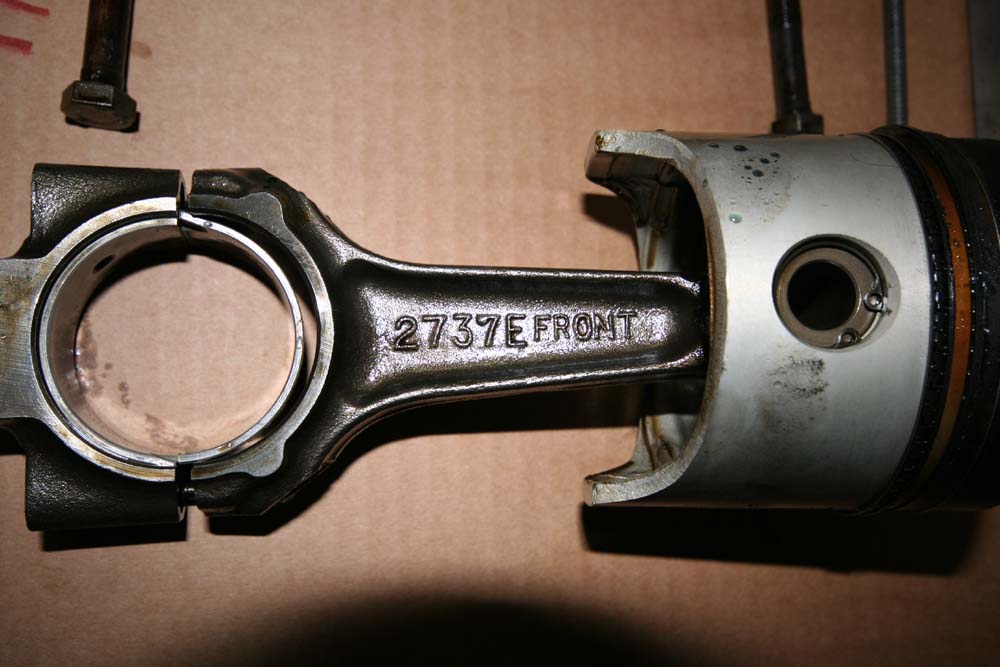
Conrods are a Ford item, pistons are AE 18647 +0.090 for the Fiesta 1300. They are commonly used to raise compression. Bore on 1300cc and 1600cc engines is the same, this allows to use both kinds of pistons. Valve pockets are a little less than 3mm deep. The bearing shells look good and can be reused. During the next days I will check prices and ask for quotations. I also have to check what tools I need. My torque wrench goes only up tp 60Nm which is not enough f. ex. to fasten the cylinder head.
Cheers.
Conrods are a Ford item, pistons are AE 18647 +0.090 for the Fiesta 1300. They are commonly used to raise compression. Bore on 1300cc and 1600cc engines is the same, this allows to use both kinds of pistons. Valve pockets are a little less than 3mm deep. The bearing shells look good and can be reused. During the next days I will check prices and ask for quotations. I also have to check what tools I need. My torque wrench goes only up tp 60Nm which is not enough f. ex. to fasten the cylinder head.
Cheers.
Labels:
conrods,
crankshaft,
Engine,
Pistons
Monday, June 17, 2013
Petrol leak test
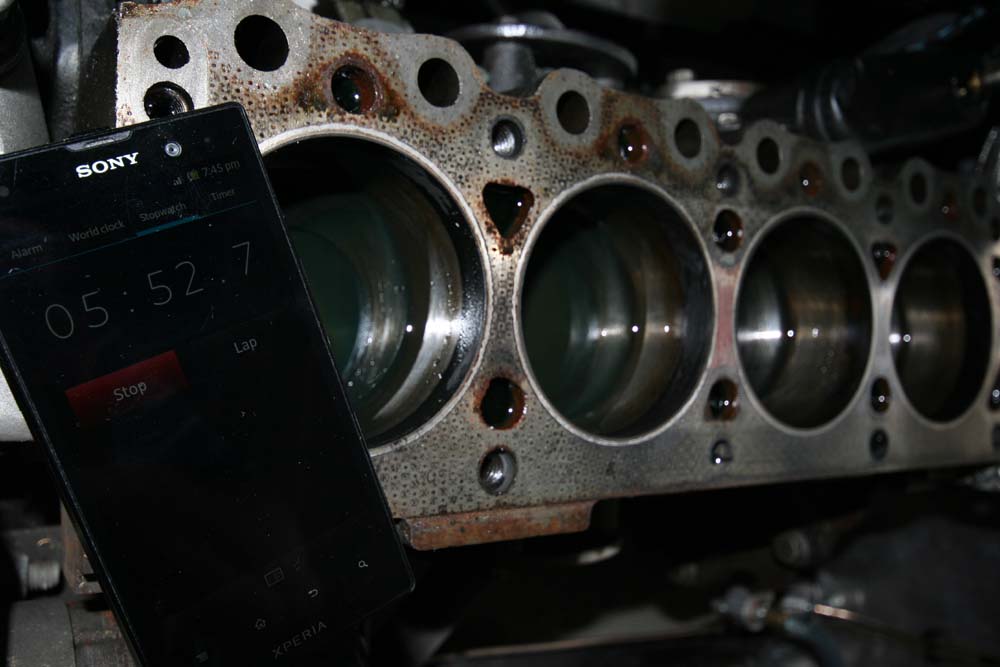
The compressed air test was not very concluant. That's why I took off the head yesterday. Other tests can now be done like the petrol leakage test. It consists in pouring some petrol on the top of the pistons. A faulty ringset will not keep the petrol on top as long as the others. With the pistons at the same height and a stopwatch, you can see what happens and how fast.
Cylinder #3 leaked well ahead of the other three. The pic shows it dry when 2 and 4 were still wet.
The same test can be repeated with the cylinder head by filling the exhaust duct (valves slightly leaking, but not a lot)...
... and the inlet duct (valves completely dry).
A Caterham owner and X/flow expert will tell me what to do next. I guess it means dismantling the bottom end, as already written in an earlier post.
Cheers.
Cylinder #3 leaked well ahead of the other three. The pic shows it dry when 2 and 4 were still wet.
The same test can be repeated with the cylinder head by filling the exhaust duct (valves slightly leaking, but not a lot)...
... and the inlet duct (valves completely dry).
A Caterham owner and X/flow expert will tell me what to do next. I guess it means dismantling the bottom end, as already written in an earlier post.
Cheers.
Labels:
Engine,
piston rings,
Pistons,
Valves
Sunday, June 16, 2013
Head off
Start of dismantling. Both manifolds off, water and oil drained, here we go. Piston tops look good, cylinder head gasket like new.
All parts and especially the valves look good. The probable reason being the piston rings, I will have to dismantle the bottom end as well.
Cheers.
All parts and especially the valves look good. The probable reason being the piston rings, I will have to dismantle the bottom end as well.
Cheers.
Labels:
Cylinder head,
Engine,
Pistons,
Valves
Wednesday, June 12, 2013
Compression
The smoke coming out of the oil catchtank tells that something is wrong with the engine. There is also some oil spit around the catchtank filter. Two possibilities: damaged piston rings or a faulty valve. One method to find out more precisely what goes wrong is to measure compression. An adaptor is fitted to the plug hole and the throttle blocked open. Unplugging the ECU prevents the pumps to run, ignition and injection don't operate. The engine must be warm, 10min. @ idle is enough.
One cylinder is measured at a time while the others keep their spark plug to seal the engine at the top. With the gauge connected to the adaptor, the engine is cranked 5 to 10 seconds, the time the needle moves up until it doesn't rise anymore.
The results are as follows: cyl1 9.9bar; cyl2 10.0bar; cyl3 6.8bar; cyl4 10.1bar.
Cylinder three clearly does not have enough compression.
Second step is to fill some oil into cylinder three and repeat the test. If compression is higher, chances are that the piston rings are faulty. If not, it may be a damaged valve. Result: 7.5bar
Enough for tonight, I will further investigate and decide what to do the coming days.
Cheers.
One cylinder is measured at a time while the others keep their spark plug to seal the engine at the top. With the gauge connected to the adaptor, the engine is cranked 5 to 10 seconds, the time the needle moves up until it doesn't rise anymore.
The results are as follows: cyl1 9.9bar; cyl2 10.0bar; cyl3 6.8bar; cyl4 10.1bar.
Cylinder three clearly does not have enough compression.
Second step is to fill some oil into cylinder three and repeat the test. If compression is higher, chances are that the piston rings are faulty. If not, it may be a damaged valve. Result: 7.5bar
Enough for tonight, I will further investigate and decide what to do the coming days.
Cheers.
Labels:
compression,
Engine,
piston rings
Wednesday, December 19, 2012
Engine runs
Some preparation work prior to first run after 14 months included the build of a launching device. This is the result and comprises a jerrycan, a battery, some switchwork (toggle for ignition, pump, ECU and charge, charging light, starter push-button) and an oil pressure gauge.
The diagram shows what is needed to start an engine. The sensors have to be connected to the ECU and the first start wasn't successfull due to an error in the crank sensor wiring. Polarity is relevant for that sensor and information is somehow spread over different documents, that's why I composed that little pic to collect all the info in one place.
After a lot of work, the engine finally runs and I was proud to call the kids and give some good kicks to the throttle so they can hear it over the phone.
Cheers.
Wednesday, February 22, 2012
Back in
One hour work with Max and Pit and the engine together with the gearbox is back in the chassis (... and always amazing how much crap lying around I discover when checking the pics :-).
This is the original place for the gearlever. To put it further back in a Seven (thus avoiding the gearlever to touch the dashboard in first, third and fifth gear), you can throw in a gear lever extension. In this case and with a X-flow engine coupled to a T9 gearbox, one of the chassis rails is in the way.
Two cuts later and the rail is out of the way. Later I will weld a similar rail at a different place to ensure stability of the frame. In this case, the place is not crucial.
The extension put in place for trial fit.
And one more for today showing the oil-fill-in of the gearbox, once for memory and once for other web users. This is an often asked question how to check the level and refill. It's the square drive screw and when the inner panels are mounted, it will not be accessible anymore. As we spilled some oil when manipulating the gearbox, we have to fill to the required level before putting the panel in place. I may add a trap in this place to allow access later on.
Cheers.
Subscribe to:
Posts (Atom)